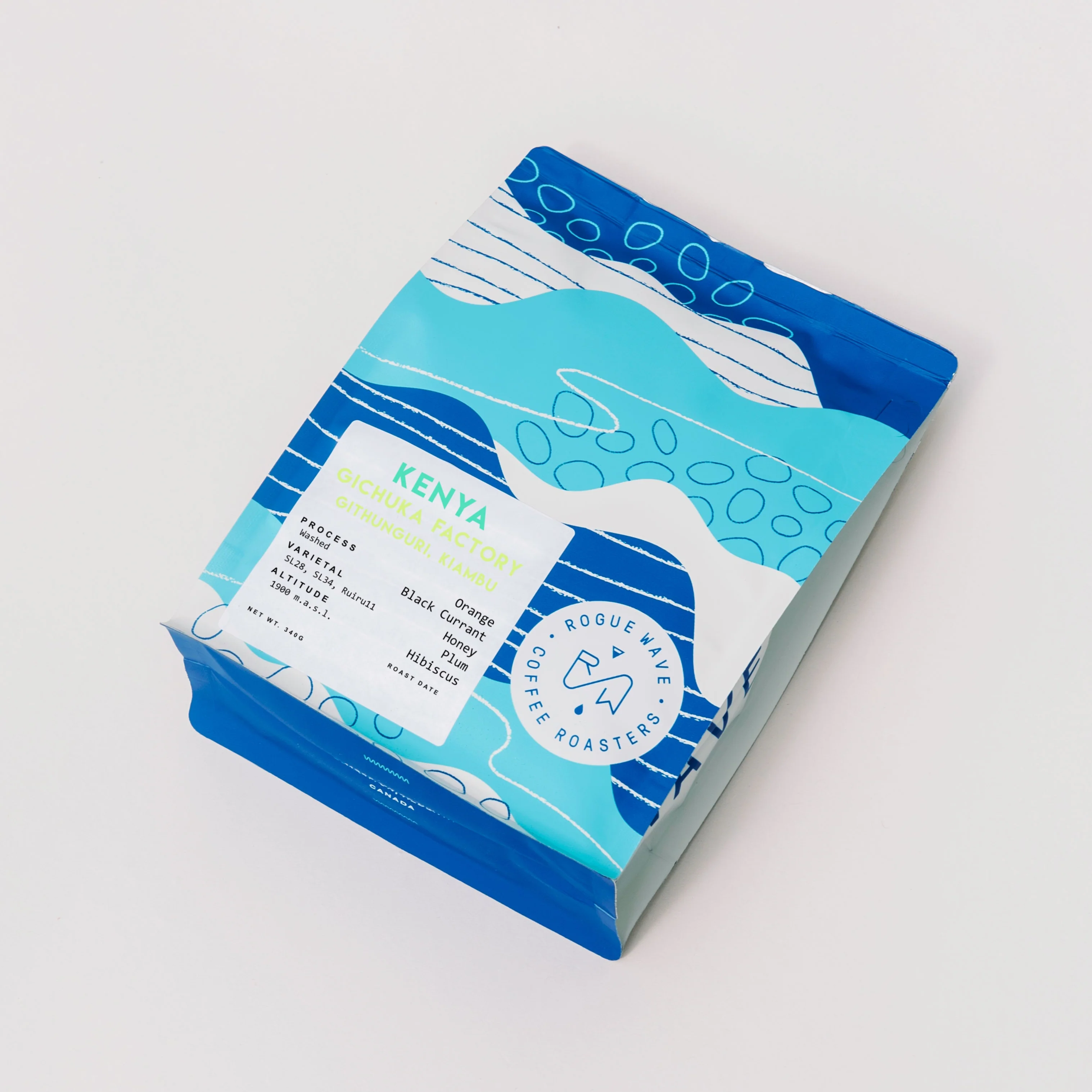
Kenya - Gichuka Factory | Washed - Archived
The factory that produced this lot lies in Githunguri, Kiambu county which is at the south-east on the foothills of Aberdare ranges and neighboring Nairobi. Gichuka Factory is under Kimaratia Farmers’ co-operative society, founded in 1995 and has 3 factories (Gachika, Gitare & Gichuka) with 2500 small farmers. Their production is around 189,998 kg with around 613 hectares of land.
In Gichuka Factory, there is an important group of employees called "Cherry-Clerks" whose responsibility is to oversee the harvesting process. Any unripe or damaged cherries will not be accepted. Cherry-Clerks will record the amount of coffee provided by each producers every day, and producers must take away their rejected cherries back, ending up with low-quality "Mbuni" during off-season. In this way they can maintain coffee quality in the factory, and the profits of producers can be maximized. The coffee is hand-picked, pulped and transferred to the factory’s fermentation tank for traditional Kenyan washed processing before being sundried.
Original: $2.94
-65%$2.94
$1.03Product Information
Product Information
Shipping & Returns
Shipping & Returns
Description
The factory that produced this lot lies in Githunguri, Kiambu county which is at the south-east on the foothills of Aberdare ranges and neighboring Nairobi. Gichuka Factory is under Kimaratia Farmers’ co-operative society, founded in 1995 and has 3 factories (Gachika, Gitare & Gichuka) with 2500 small farmers. Their production is around 189,998 kg with around 613 hectares of land.
In Gichuka Factory, there is an important group of employees called "Cherry-Clerks" whose responsibility is to oversee the harvesting process. Any unripe or damaged cherries will not be accepted. Cherry-Clerks will record the amount of coffee provided by each producers every day, and producers must take away their rejected cherries back, ending up with low-quality "Mbuni" during off-season. In this way they can maintain coffee quality in the factory, and the profits of producers can be maximized. The coffee is hand-picked, pulped and transferred to the factory’s fermentation tank for traditional Kenyan washed processing before being sundried.